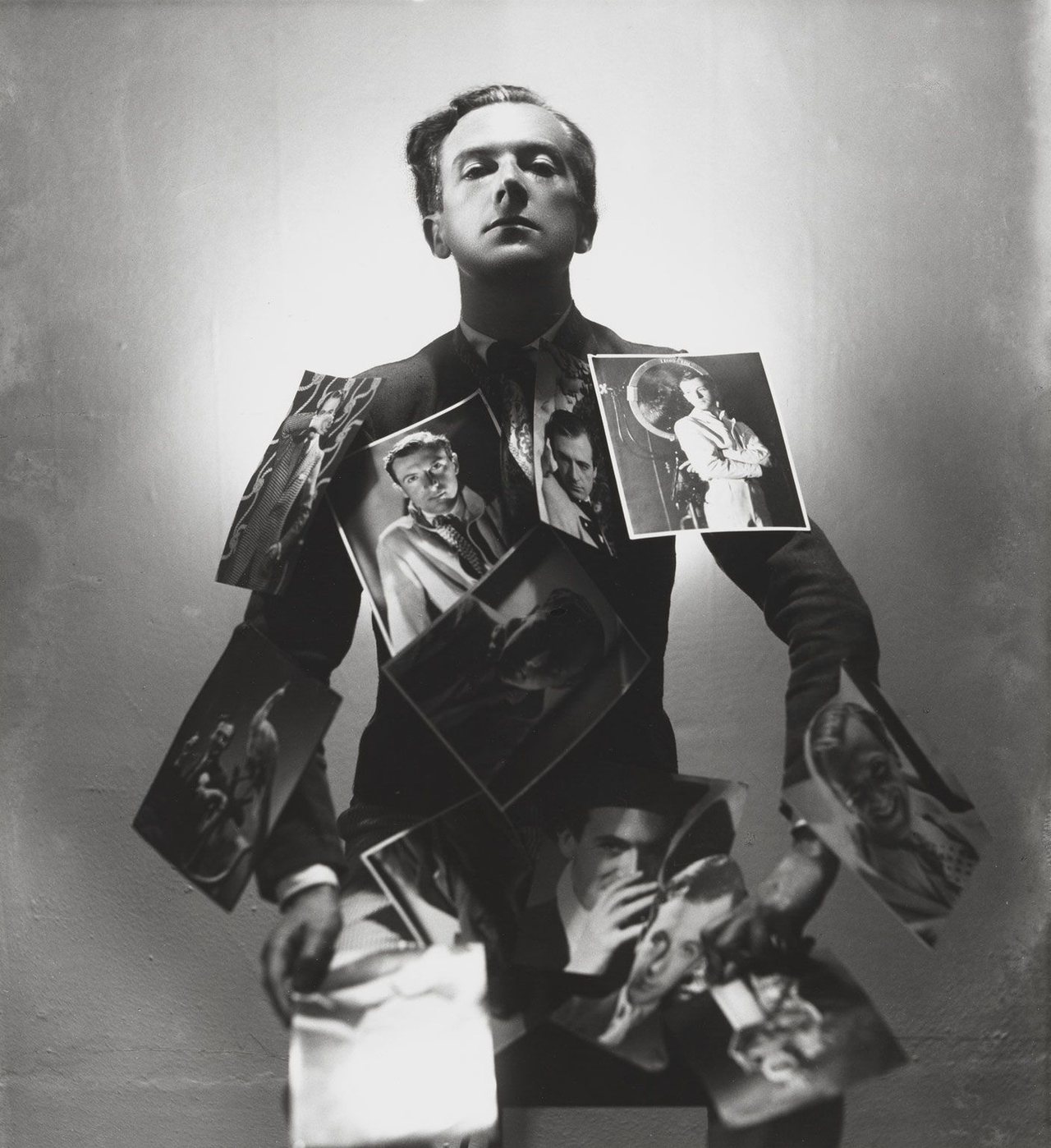
Collectors' Stories: Cecil Beaton
The photographer who dressed his sitters in props kept the props. From the circus bedroom at Ashcombe to the velvet drawing room at Reddish House: the private collection of Cecil Beaton.
Cecil Beaton spent his life deciding how things should look. Born in Hampstead in 1904, he was given his first camera as a boy, and by his early twenties he had turned the family house in Sussex Gardens into a studio of his own invention. His sisters posed with their faces mirrored in the lid of a piano, and the poet Edith Sitwell lay on a chequered floor between two plaster cherubs, as still as a figure on a tomb. In 1927 he held his first exhibition in London. The following year he sailed for New York, and from then on he worked for Vogue on both sides of the Atlantic.
In the half century that followed he photographed the Bright Young Things, the society set of the late 1920s, then Queen Elizabeth in the gardens of Buckingham Palace in 1939, the war for the Ministry of Information, and Greta Garbo, Marilyn Monroe and Audrey Hepburn. In old age Andy Warhol and Mick Jagger sat for him too. He designed the costumes and sets of Gigi and My Fair Lady, which brought him three Academy Awards, and the diaries he published in his lifetime remain among the sharpest accounts of his world. He was knighted in 1972. Two years later a stroke took the use of his right arm, and he died at Reddish House, his home in Wiltshire, on 18 January 1980.
He could not live in an ordinary room. In 1930 he took a small house hidden in a Wiltshire valley, Ashcombe, and kept it for fifteen years. In 1935 he rented a flat at Rutland Court, in Knightsbridge. In 1940 he bought 8 Pelham Place, in South Kensington, and in 1947 Reddish House, at Broad Chalke, where he lived until his death. In New York he even decorated a hotel suite for himself. He furnished each of his houses, then photographed it, drew it and described it in print, so that we know his rooms almost as well as we know his portraits.
Earlier this month we began On Collecting, five essays about a single desire, to form a collection that resembles no one but its maker, and about how hard that desire is to recognise. Beaton is an unusual subject for them. He never formed a collection in the museum sense, with a catalogue and a plan. What he gathered was a way of living among things, and he arranged each room as carefully as he lit a sitter. Taken house by house, the five questions follow a young man who furnished with cellophane and plaster cherubs and became a collector whose pieces still return to the saleroom with his name attached.
The rest of his story, and the pieces he lived with, are on Substack.
Continue reading on SubstackAll articles